Quick Overview
Artemis works on Projects. A Project is a codebase connected to a repository, plus the Artemis work around it: Rules, Scripts, Branches, Plans and Discovery Runs. Inside a Project the sidebar shows Overview, Agents, Maintain, Discover, Plan, Branches, Files and Settings.
Getting started
Log in to Artemis
Open Artemis in your browser, or your own deployment's address. After logging in you land on the Projects page. Use Search or run an action (⌘K) at the top of the sidebar to find Plans, Branches and Discovery Runs, or to run an action.
New user? Create your account here
Create a Project
On the Projects page, click New and choose how to start:
- Connect Git Repository to import a repository from your Git provider.
- Open a sample project to try Artemis on ready-made code.
- Upload a .zip file to import an archive of your code.
- Start from scratch with a Plan to describe what you want to build and let the planning agent create a Project and a Plan.
For details, see Import your codebase.
Connect a Runner
Anything that builds, tests or measures your code runs on an Artemis Runner on a machine you choose. Set one up under Settings → Runners, then select it and add a Script under the Project's Settings → Runner and Scripts. Chat, planning and Scans do not need a Runner.
Connect your coding agent
To use Artemis from Claude Code, Codex or another coding agent, open Connect Your Agent in the main sidebar. Its setup prompt installs the Artemis CLI, the Artemis Skills and sign-in for you. See Connect Your Agent.
Maintain
Maintain keeps a codebase in line with your standards.

- Rules define what to look for. Draft them with the Maintain agent, write them in Markdown, copy them from another Project, or add them from the Rule Library.
- Scan searches the code against the Rules you select and records Issues. You can add focus guidance and limit how many Issues it raises.
- Triage each Issue as confirmed or a false positive, or archive it. Mention
#Issuesand#Rulesdirectly in chat. - Fix an Issue with a coding agent, hand a harder one to a Discovery Run with Fix in Discovery, write a Plan first with Plan a fix, or give it to your own coding agent with Copy for local agent.
Discover
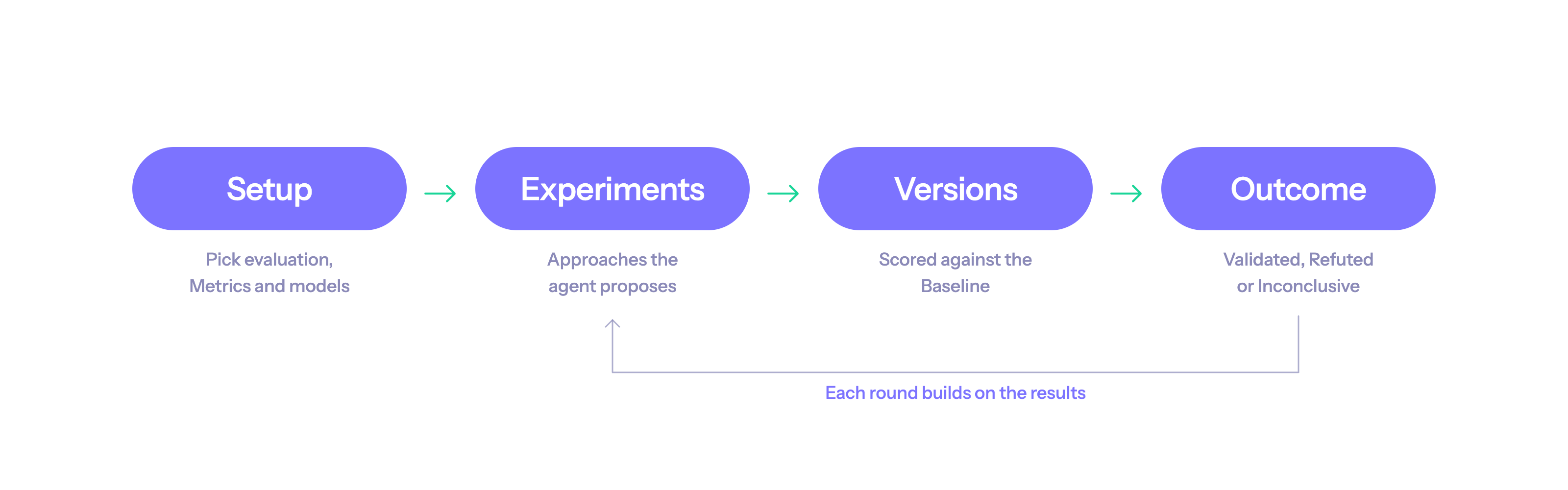
A Discovery Run explores ideas toward an Objective and produces code Versions, each scored against the Baseline. Starting one takes four setup steps: Evaluation, Objective, Preferences and Summary. The run's Overview shows the best Version so far, and What next? suggests continuing the run, exploring a direction or starting a new one.
- Objective: what you want to improve, with its scope and constraints.
- Experiments: approaches the agent proposes. They move from Draft to Queued, In progress and Done, and a finished Experiment is recorded as Validated, Refuted or Inconclusive.
- Versions: the code variants each Experiment produces, run on your Runner and scored.
- Metrics: what each Version is scored on, each with a direction and an importance tier.
Plan
A Plan breaks work into Tasks before any code is written. The planning agent asks questions, proposes Tasks grouped by phase, and Build plan implements the agent Tasks on a new Branch.
Branches
Every code change Artemis makes, from a Discovery Version, a Plan, a Fix or a change you describe on the Branches page, lands on a Branch: an Artemis bundle of proposed changes. Review the diff, verify it on a Runner from the Scripts tab, then publish it to your Git provider or open a Pull Request.
Agents
The Agents page lists every agent working on the Project: chats, planning agents, Scans, Fixes, Discovery Runs and coding agents. Start a new one from the composer at the top, and follow any of them while they run in the background.