Version 3.0.0
Release date: July 22nd, 2026
Version 3.0.0 is a significant milestone for Artemis — introducing Maintain as a first-class module for automated codebase auditing and fixing, a ground-up rebuild of Discovery, and a wave of platform-wide improvements across agents, memory, models, and navigation.
Maintain
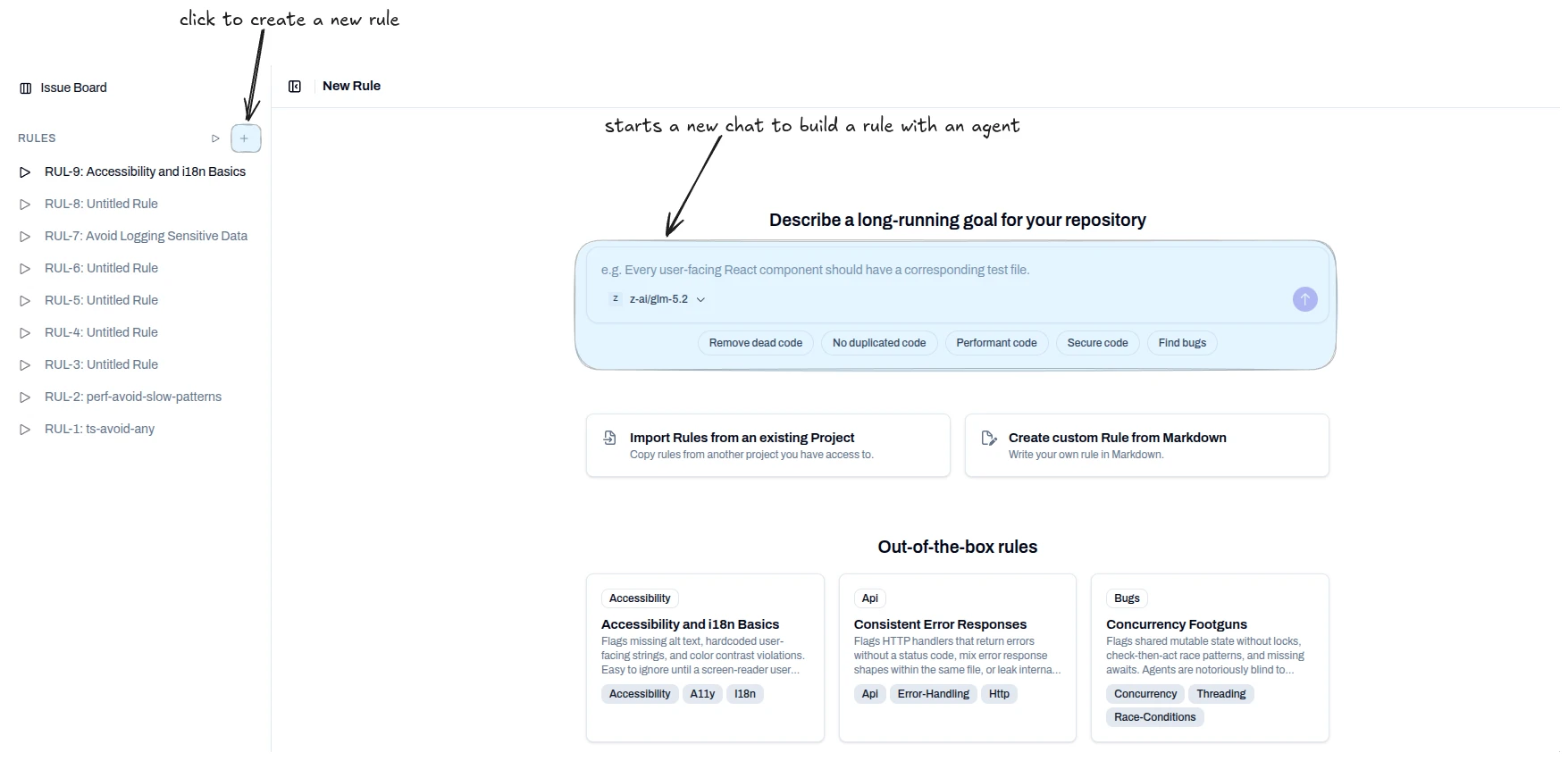
Maintain gives you a structured workflow for keeping your codebase clean: define rules, scan for issues, triage findings, and fix them directly with an Artemis coding agent.
Rules
Create, import, and manage the rules that govern your codebase:
- Create a rule with agent assistance, or write one directly in Markdown format
- Import rules from another project or from Artemis's built-in out-of-the-box library
- Newly created projects come pre-seeded with three rules: Logic and Correctness Bugs, Inefficient Code Patterns, and Dead and Unreachable Code
- Import existing rules from a
claude.mdconfiguration file - Out-of-the-box rules now support tags for easier filtering
- Improved scanning flow with a clearer, easier-to-read rule summary
Scan
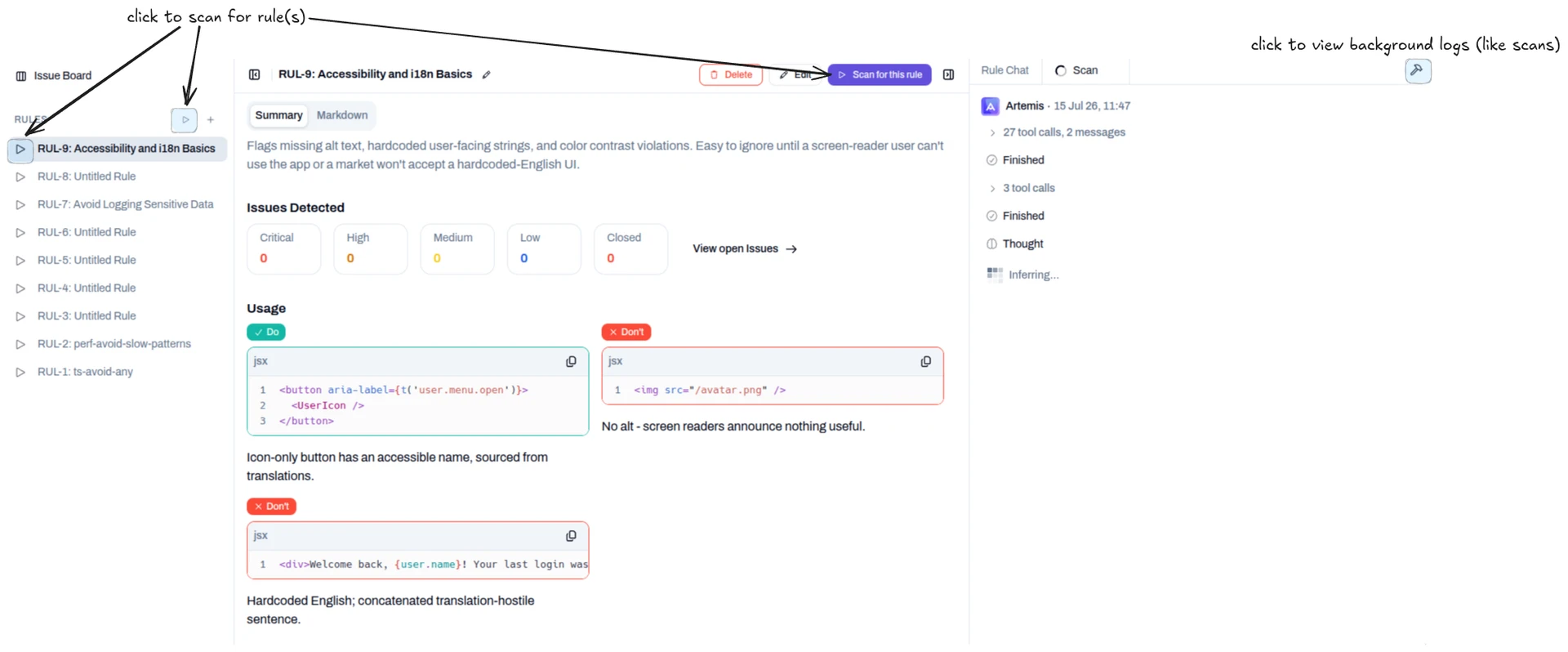
Run targeted scans against your codebase using one or more rules:
- Select up to 20 rules per scan
- Provide additional context when scanning — specify where in the code to look or which data sources to depend on
- Set a budget for how many issues to find (0 = unlimited)
- Choose the main model for the scan; a cost-efficient sub-agent handles deeper analysis automatically
- View live scan logs that show which rules are being applied, the prompt used, files scanned, and a final summary of issues found
- Scans support MCP tools if you have integrations configured
- Mention rules and issues directly in chat by their ID using
#Rulesand#Issues
Triage & Fix Issues
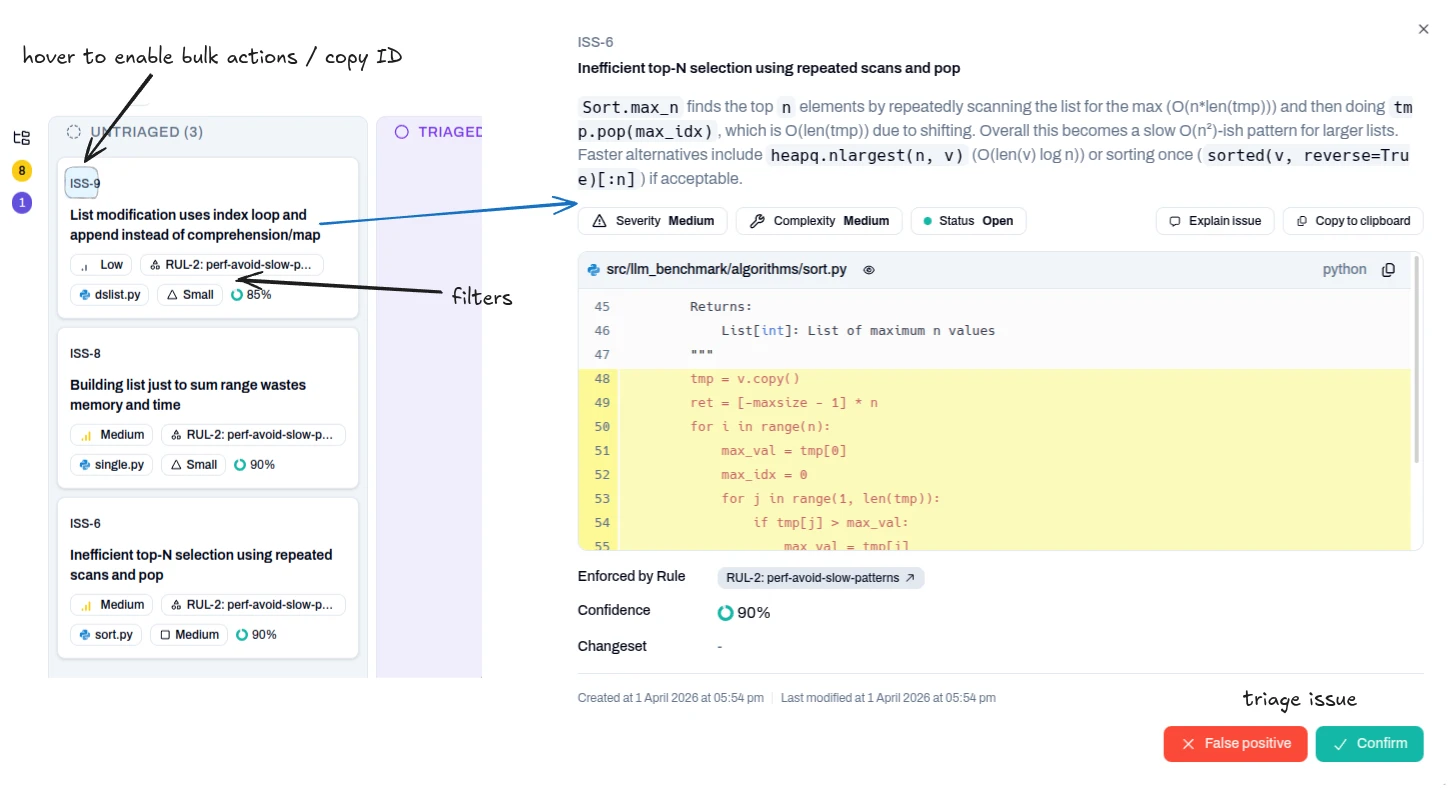
Review and act on scan results:
- Fix any issue directly from the issue board — no need to change status first; select a model and the agent handles the rest
- Start a chat pre-filled from "Explain issue" for deeper investigation
- Chat now shows the full scan pipeline via issue-summary cards, a scan-start card, and a final results card
- Complex issues can be handed off to Discovery or a Build plan — Discovery is suggested automatically when the issue warrants deeper exploration
Discovery
Discovery has been rebuilt from the ground up.
Agentic Improvements
- Ideas and experiments unified into a single workflow — less switching, more doing
- Experiments now have lifecycle statuses so you always know where each one stands
- Generate multiple experiment versions simultaneously for faster exploration
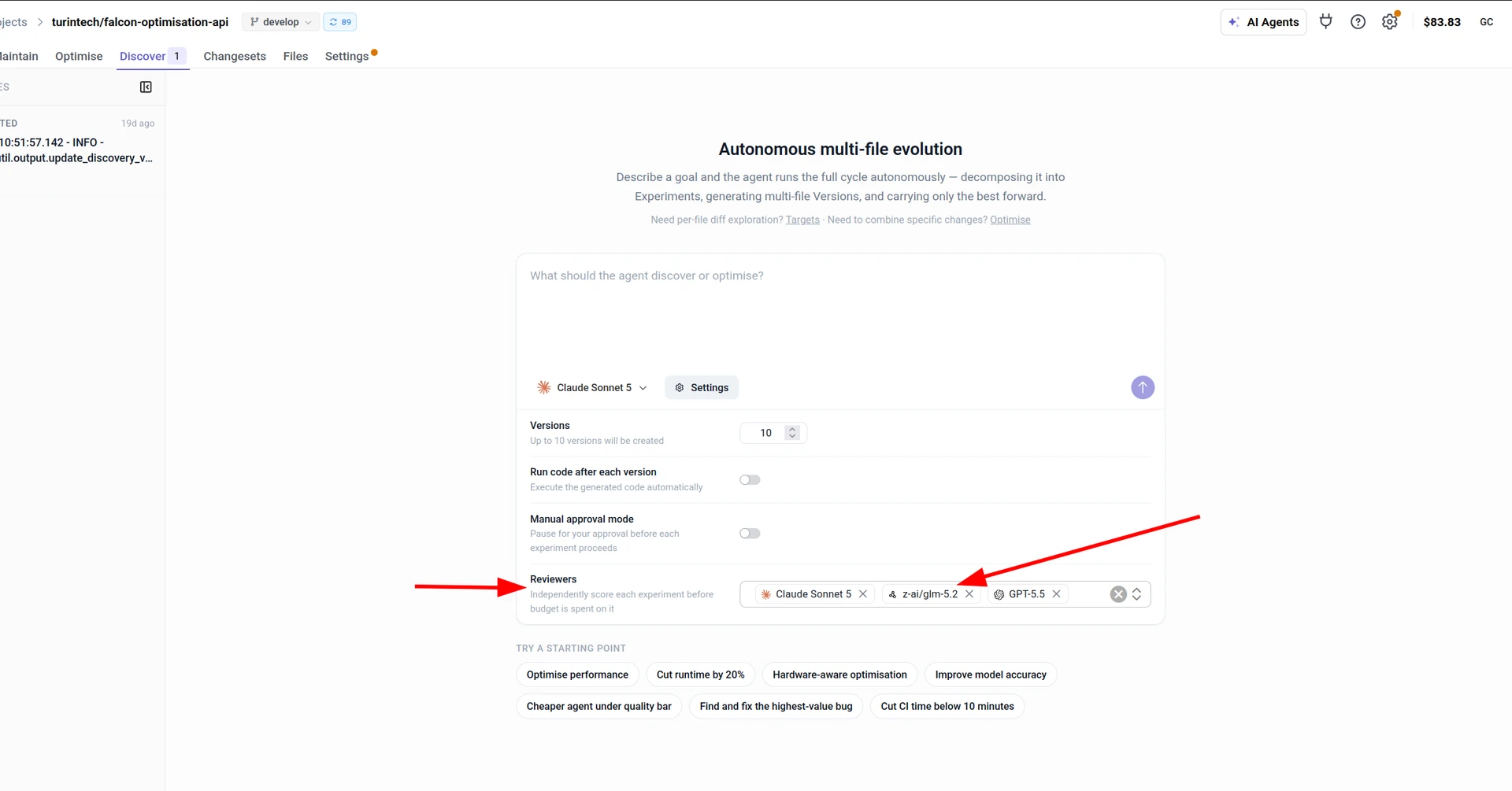
- Multi-LLM review panel — select multiple LLMs to review suggestions generated by another model, with confidence ratings and critique notes
- Multi-metric tradeoff plot — compare generated variants against the baseline across multiple metrics at once
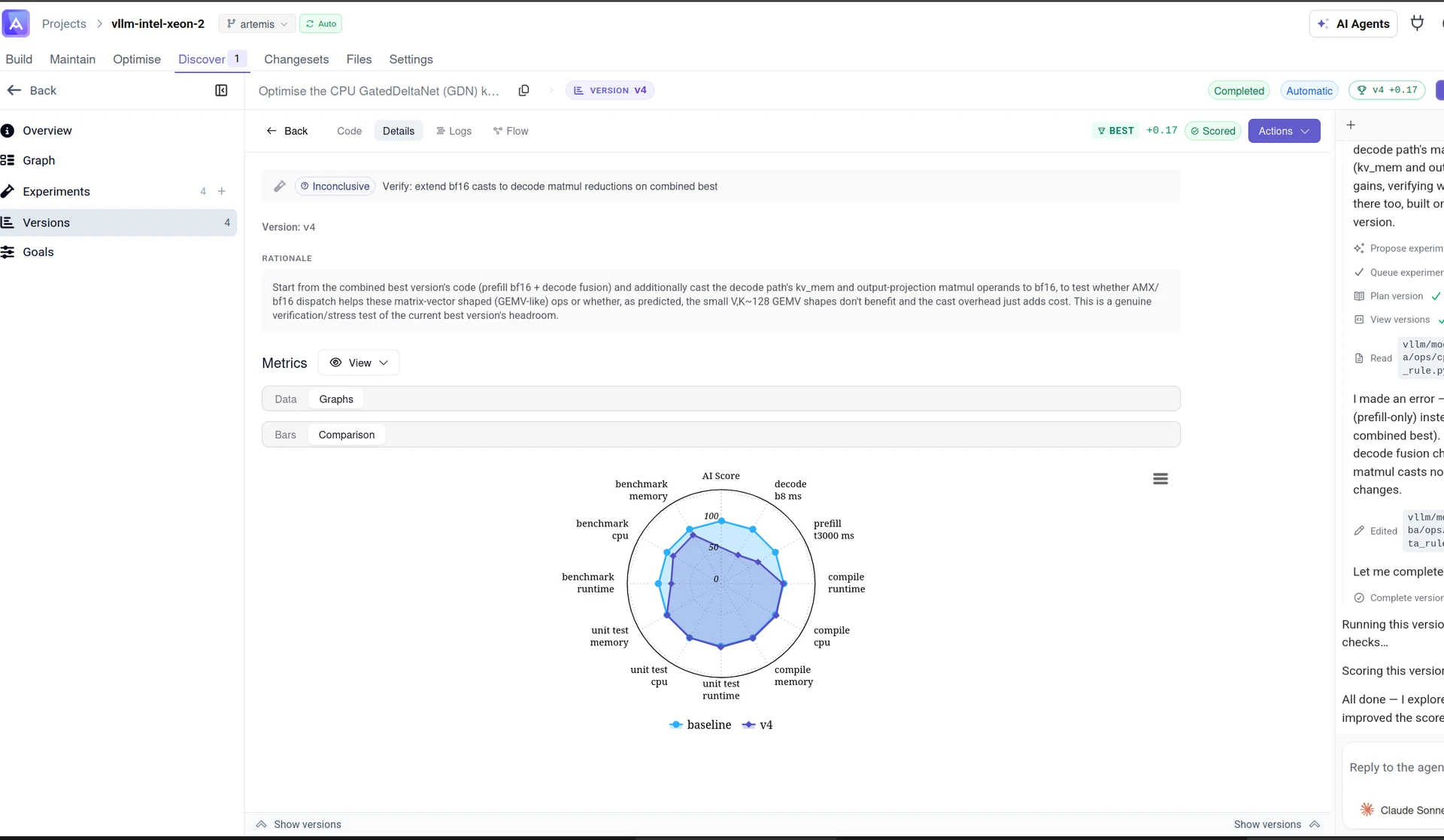
- Pin optimisation goals and configure metric weights
- Specify optimisation focus (e.g. maximise throughput)
- Improved agent budget utilisation
- Cancel and resume are now much more reliable
UI
- The Discovery board is now the default view
- Inline Queue/Dismiss actions
- Bulk select and combine experiments
- Experiment placeholders persist when navigating away
Agents
- Proper streaming directly from the LLM — noticeably faster for long outputs
- Global checkpoint resume — if any agent fails, it recovers from the last good state automatically
- Multi-tab chat window with a tabbed composer and collapsible sidebar
- Clearer error handling — a dedicated alert for detected loops, and errors shown by type with an expandable details panel
- Prompt suggestions on empty chats, plus stop and retry controls in read-only chats
- If a run's model is no longer available, you're prompted to pick a replacement on retry
Memory
- Memories page — browse your Discovery experiments across all projects, with search and built-in chat
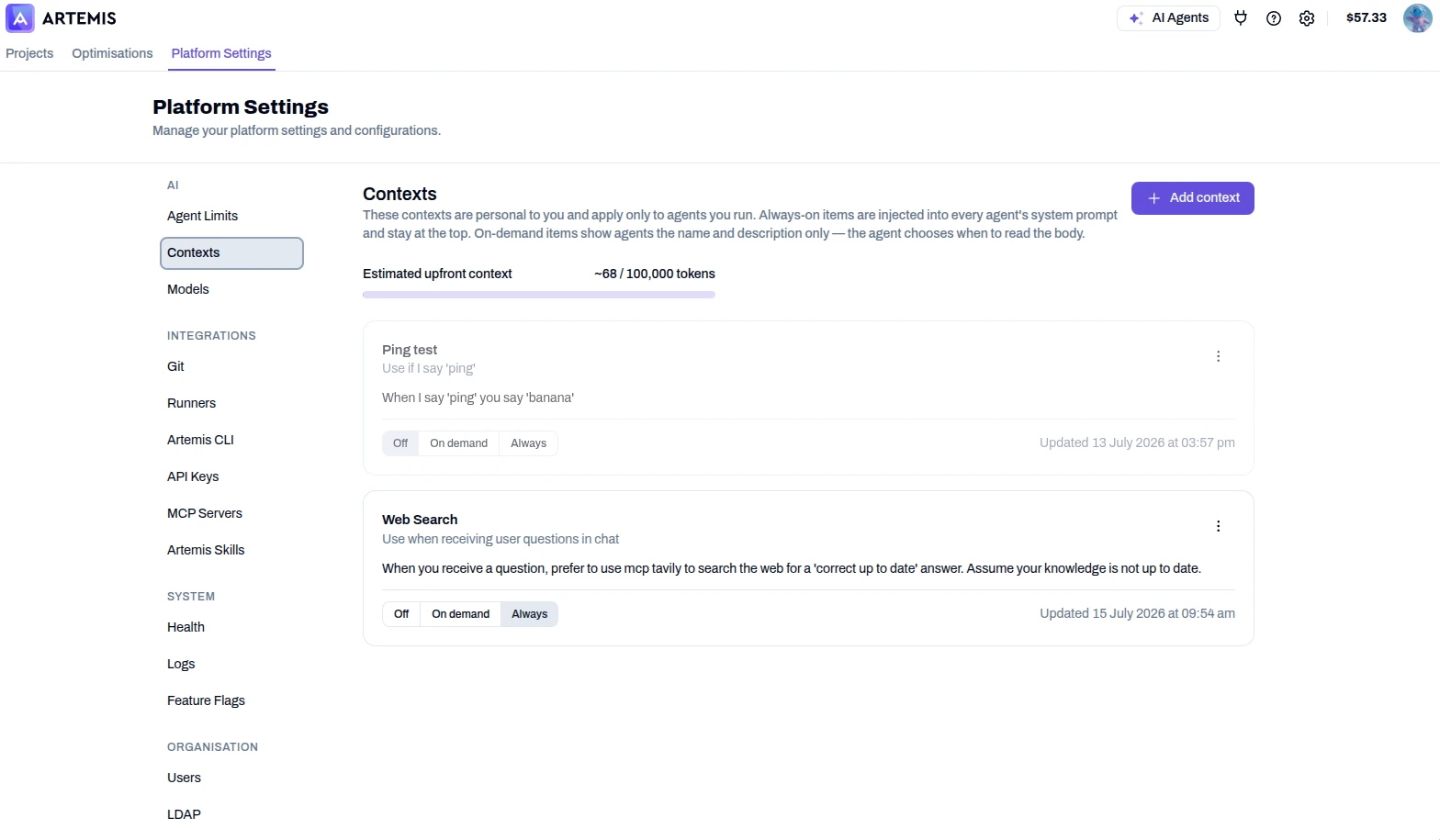
- Contexts page — manage what agents remember, with availability controls and a token-budget bar
- Modify agent memories directly from platform settings
- Three availability modes per context item:
- Always — the agent always has access to this context
- On Demand — the agent decides when to read it
- Off — the agent ignores it entirely
- Affected agents:
changeset_coder,chat,discovery,maintain,planning,quest_coder,scan
Changesets & PRs
- Changeset and PR actions are disabled when nothing has changed, with a clearer empty state for same-version diffs
- New auto-generate PR title and description button
Models & Profiles
- The model picker shows cost per 1M tokens and warns when a model needs cost configuration
- Pick models by effort tier (Low / Medium / High) instead of memorising model names
- Per-run cost and budget caps
- Shared model picker used consistently across the app
- Per-profile SSL verification, including a custom CA certificate option
- Support for managing AI providers: OpenAI, Anthropic, Vertex AI, Azure OpenAI, OpenRouter, and custom endpoints
- Import provider model catalogues and validate configured models
Settings & Onboarding
- Redesigned project settings, reorganised into General and Scripts & Benchmarks tabs
- "Get Started" checklists and attention dots highlight essential setup steps
- Guided runner setup flow
- New admin-only platform logs page with live log tailing
Navigation
- Unified project breadcrumbs with a project switcher
- Consistent page headers across the app
- Contextual pro tips throughout projects, changesets, and agents
Under the Hood
Retired an old internal system in favour of a more standard Git + LLM setup, and moved project storage to a modern S3-style backend.
Discontinued
- Discord integration removed
- Code extraction now runs exclusively through agents — non-agent extraction flows have been removed
- Removed the non-functional Auto Pull Request toggle
- Removed the split-version action and unused sort options (size of fix, version count)